- Blue: Symbolizing the heavenly realm, blue represents the divine presence and serves as a reminder of God’s authority and power.
- Purple: Associated with royalty and wealth, purple signifies the honor and majesty of God. It also signifies the authority given to the priests as they serve as mediators between God and the people.
- Scarlet: This vibrant red color symbolizes sacrifice and atonement. It represents the shedding of blood required for the forgiveness of sins.
- White: Representing purity and righteousness, white garments signify the holiness and moral integrity of the priests. It also symbolizes the forgiveness and cleansing of sins.
Josephus “Antiquities Of The Jews”
4. The high priest is indeed adorned with the same garments that we have described, without abating one; only over these he puts on a vestment of a blue color. This also is a long robe, reaching to his feet, [in our language it is called Meeir,] and is tied round with a girdle, embroidered with the same colors and flowers as the former, with a mixture of gold interwoven. To the bottom of which garment are hung fringes, in color like pomegranates, with golden bells [13] by a curious and beautiful contrivance; so that between two bells hangs a pomegranate, and between two pomegranates a bell. Now this vesture was not composed of two pieces, nor was it sewed together upon the shoulders and the sides, but it was one long vestment so woven as to have an aperture for the neck; not an oblique one, but parted all along the breast and the back. A border also was sewed to it, lest the aperture should look too indecently: it was also parted where the hands were to come out.
Exodus 28:30 And thou shalt put in the breastplate of iudgement, the Urim and the Thummim, and they shall bee vpon Aarons heart, when he goeth in before the Lord: and Aaron shall beare the iudgement of the children of Israel vpon his heart, before the Lord continually.
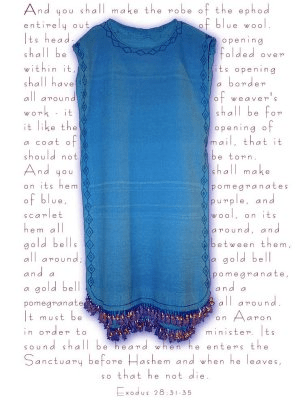
28:31 And thou shalt make the robe of the Ephod all of blew.
28:32 And there shall bee an hole in the top of it, in the mids thereof: it shall haue a binding of wouen worke, round about the hole of it, as it were the hole of an habergeon, that it be not rent.
28:33 And beneath vpon the hemme of it thou shalt make pomegranates of blew, and of purple, and of scarlet, round about the hemme thereof, and belles of gold betweene them round about.
28:34 A golden bell and a pomegranate, a golden bell and a pomegranate, vpon the hemme of the robe round about.
Exodus 39:3 And they did beate the golde into thinne plates, and cut it into wiers, to worke it in the blew, and in the purple, and in the scarlet, and in the fine linnen, with cunning worke.
Exodus 39:22 And he made the robe of the Ephod of wouen worke, all of blew.
39:23 And there was a hole in the midst of the robe as the hole of an habergeon, with a band round about the hole, that it should not rent.
39:24 And they made vpon the hemmes of the robe pomegranates, of blew, and purple, and scarlet, and twined linnen.
39:25 And they made belles of pure gold, and put the belles betweene the pomegranates, vpon the hemme of the robe, round about betweene the pomegranates.
39:26 A bell and a pomegranate, a bell and a pomegranate round about the hemme of the robe to minister in, as the Lord commanded Moses.
Jamieson-Fausset-Brown Bible Commentary
31-33. the robe of the ephod all of blue—It was the middle garment, under the ephod and above the coat. It had a hole through which the head was thrust, and was formed carefully of one piece, such as was the robe of Christ (Joh 19:23). The high priest’s was of a sky-blue color. The binding at the neck was strongly woven, and it terminated below in a fringe, made of blue, purple, and scarlet tassels, in the form of a pomegranate, interspersed with small bells of gold, which tinkled as the wearer was in motion.
Matthew Poole’s Commentary
Not the ephod itself, for that was prescribed before, Exodus 28:6, but a long and loose robe called the robe of the ephod, because it was worn next under it, and was girded about the high priest’s body with the curious girdle of the ephod.
Gill’s Exposition of the Entire Bible
And thou shall make the robe of the ephod all of blue. This was a different garment from the ephod, was longer than that, and was under it, and of different materials: that was made of gold, blue, purple, scarlet, and fine linen; this only of linen, and wholly of a blue colour, without any curious figures upon it, as were on that: in Exodus 39:22, it is said to be of woven work; it was woven from top to bottom, and had no seam in it: so Josephus says (b),”the coat did not consist of two parts, nor was it sewed upon the shoulder, nor on the side, but was one long piece of woven work;”and such was the seamless coat our Lord Jesus Christ wore, literally understood, John 19:23 and both were an emblem of his perfect righteousness, which has nothing of the works of men joined to it, to justify them before God, and make them acceptable to him: for this robe signifies the robe of Christ’s righteousness, the best robe; it has its name from a word which signifies prevarication or sin, because it covers the sins of God’s people; the matter of it was linen, and so fitly points at the fine linen, that is the righteousness of the saints, and being blue or sky coloured may denote heaven and happiness, which that entitles to, see Matthew 5:20, the Septuagint version calls it a garment down to the feet, using the same word as in Revelation 1:13 and fitly agrees with that righteousness with which all Christ’s members are covered and justified, Isaiah 45:24.
(b) Antiqu. l. 3. c. 7. sect. 4.
Kings Commentary In Exo_39:3 we read a detail that is not in Exodus 28: a golden thread that is woven in the ephod. This is a picture of Divine glory (gold) shining through all the traits of the holy Manhood of the Lord Jesus. All truths concerning His person are interrelated. Nothing can be separated, although there may be distinction. For example, we see that He sleeps as Man on a boat because He is tired, while standing up a little later, and rebuking the wind and the sea as God (Mar_4:35-41 ).
He exercises His high-priesthood in heaven. The results are being felt on earth. We see that in the hem of the garment. At the hem are a golden bell and a pomegranate. A Divine testimony is given (bell) and there is fruit for God (pomegranate). The sound is heard when entering the sanctuary. After the Lord Jesus entered heaven, the Holy Spirit came to earth to testify and form the church. The coming of the Holy Spirit has been accompanied by “a noise like a violent rushing wind” (Act_2:2 ).
November 2, 2023 by Tiffany Christensen
“One of the most prominent colors used in priestly attire is blue, which represents the heavens and the divine nature of God. Blue is associated with the sky, symbolizing transcendence and the spiritual realm. It serves as a reminder of God’s holiness and his presence among his people.
Another important color is purple, which signifies royalty and honor. It’s often associated with kingship and is used to convey the priest’s role as a representative of God and mediator between God and humanity.
White is a color often seen in priestly garments, symbolizing purity and righteousness. It represents the priest’s commitment to living a holy life and serving as a model of moral integrity for the community.
Red is a color that carries multiple interpretations. It can symbolize sacrifice and atonement, as seen in the blood of animals offered in the temple. It also represents the divine love and passion of God towards his people.
Yellow and gold are colors that symbolize divinity, glory, and beauty. They represent the radiance of God’s presence and the eternal nature of his kingdom.
Here are four important interpretations of color symbolism in priestly vestments:
Blue: The color blue represents the divine presence and heavenly realms. It’s associated with God’s commandments and the sky above, symbolizing the connection between heaven and earth.
Purple: Purple is a royal color, symbolizing power and authority. It represents the kingship of God and His sovereignty. Purple was used in the vestments of high-ranking priests, highlighting their role as mediators between God and the people.
White: White symbolizes purity and holiness. It represents the righteousness and innocence of the priests who served in the temple. It also signifies the forgiveness of sins and the cleansing of impurities.
Red: Red signifies sacrifice and atonement. It represents the shedding of blood and the offering of sacrifices to God. The red color in the vestments reminds priests and the people of the need for repentance and the ultimate sacrifice of Jesus Christ.”
It is possible that tradition got its roots from Hannah making Samuel a little coat each as he grew. Which makes sense, it is not like they had a Walmart or a mall on each corner.
1 Samuel 2:19 Moreouer, his mother made him a litle coate, and brought it to him from yeere to yeere, when she came vp with her husband, to offer the yeerely sacrifice.
This we also read Jacob makes Joseph a coat.
Genesis 37:3 Now Israel loued Ioseph more then all his children, because he was the sonne of his old age: and he made him a coat of many colours.
In everyday life, men and women alike wore garments often referred to as “tunics.” A tunic was a simple, one-piece robe, usually belted at the waist, with a hole for the head and two holes for the arms. People wore both an inner garment and an outer garment, each with a similar shape.
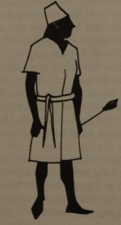
The inner garment resembled a long, loose-fitting T-shirt or a kimono. It was made of linen, cotton, or sometimes soft wool. For penitential reasons some would occasionally wear inner tunics made of sackcloth or camel hair. The earliest of these garments were made without sleeves and reached only to the knees; later the garment often extended to the wrists and ankles. A man wearing only this inner garment was said to be naked (e.g., 1 Samuel 19:24, Isaiah 20:2–4). Nothing at all was worn underneath the inner garment (except by Essene men, who wore a close-fitting loincloth).
The belt (also called a cincture or girdle) was a band of cloth, cord, or leather that could be loosened or tightened. It was worn around the inner and/or outer garment. Its use prevented the flowing robes (often long) from interfering with movement. The biblical expression “to gird up the loins” meant to put on the belt, thus freeing the lower legs to permit work and easy walking. The expression signified that the person was ready for service; it is largely equivalent to the modern expression, “roll up your sleeves.”
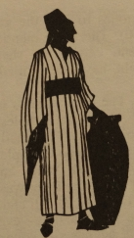
The outer tunic, also called a mantle or robe, was worn over the inner tunic. It consisted of a square or oblong strip of cloth with a hole for the head. Sometimes it had sleeves and sometimes was more like a poncho, with the area for the arms cut back. It was worn as a protective covering; people did not go out in public without some sort of outer tunic. Jewish men had tassels (called tzitzit) attached to the corners of their mantles, reminding them of the constant presence of the Lord’s commandments. Because the outer tunic was large and flowing, it was usually drawn in with a belt. The outer belt was often decorated with embroidery or even precious stones.

 Watchmen On The Pod